

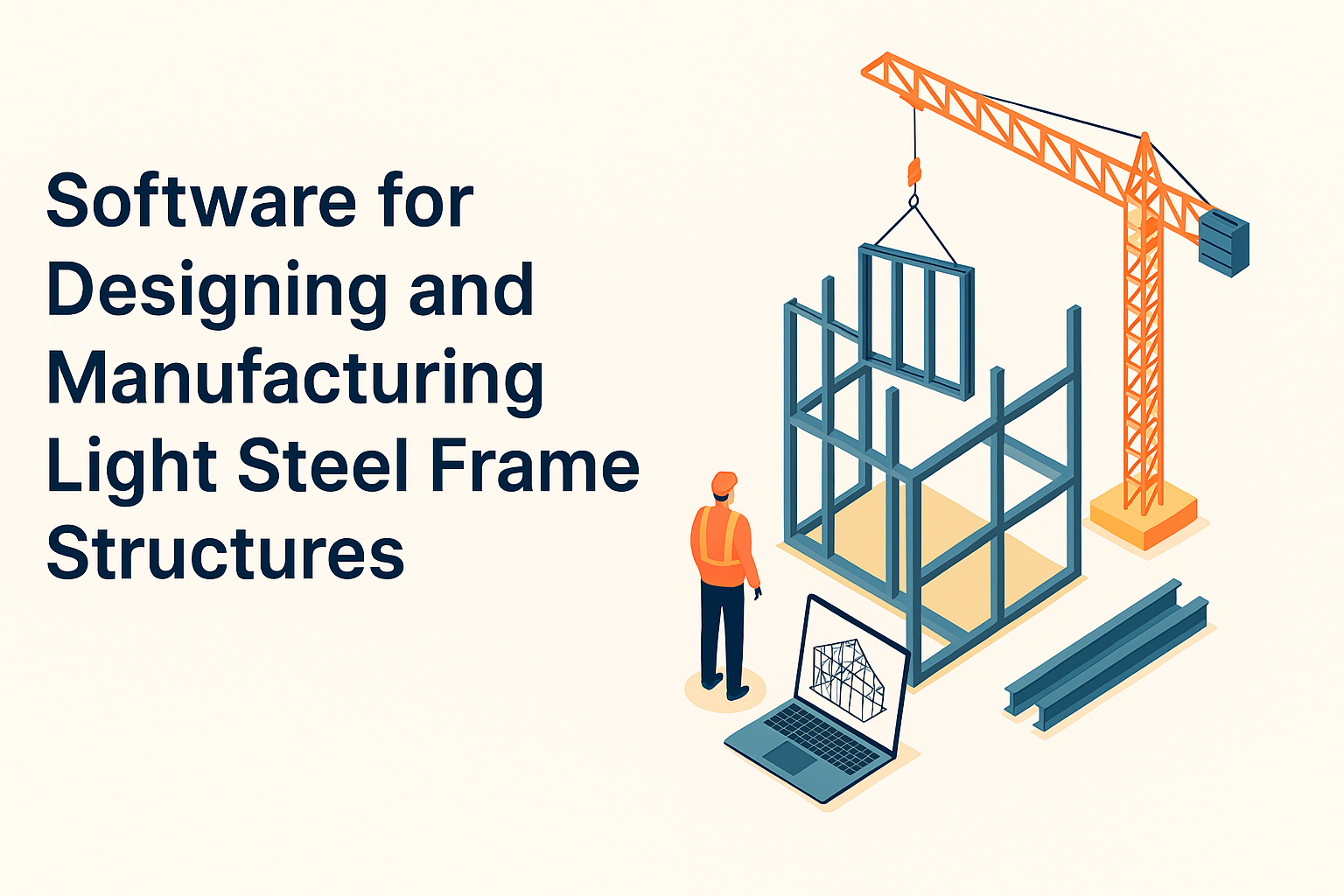
Software for Designing and Manufacturing Light Steel Frame (LSF) Structures
Introduction
Light Steel Frame (LSF) construction, also known as cold-formed steel framing, is a modern building method that utilizes thin-gauge steel sections to create lightweight, durable, and efficient structures. LSF is widely used in residential, commercial, and modular buildings due to its speed of assembly, sustainability, and cost-effectiveness. Designing LSF structures requires specialized software that can handle structural analysis, detailing, and integration with manufacturing processes. This article explores key software options for LSF design, including their capabilities, advantages, and disadvantages. Finally, it discusses software that generates production files compatible with roll former machines, which are essential for automating the fabrication of steel profiles.
Software for Designing LSF Structures
Several software tools are available for designing LSF structures, ranging from specialized cold-formed steel programs to more general BIM (Building Information Modeling) platforms adapted for LSF. Below, we detail some of the most prominent ones, based on industry usage and features.
1. Vertex BD
Vertex BD is a professional BIM software specifically tailored for cold-formed steel and timber framing. It supports the entire workflow from architectural design to manufacturing.
Capabilities:
- 3D modeling and detailing for prefab, modular, residential, and commercial LSF projects.
- Automatic generation of material reports, shop drawings, and CNC data for manufacturing.
- Import/export of various file formats, including IFC for interoperability.
- Tools for creating 2D plans, elevations, and assembly instructions.
- Integration with roll-forming machines for direct data export.
Advantages:
- Produces plans up to 2X faster and reduces on-site errors through automated framing rules.
- Standalone software that doesn't require additional platforms like Revit.
- Comprehensive for light gauge steel, with strong support for cross-checking and collaboration.
Disadvantages:
- Learning curve for new users due to its specialized features.
- May require customization for complex projects, which can increase setup time.
- Higher cost for full licensing, potentially limiting accessibility for small firms.
2. FRAMECAD Structure (Steelwise)
FRAMECAD Structure is an integrated design and engineering software for cold-formed steel, combining detailing, analysis, and manufacturing optimization.
Capabilities:
- Real-time structural analysis, precise detailing, and 3D modeling.
- Automated engineering calculations for walls, floors, roofs, and trusses.
- Generation of bill of materials (BOM), cut lists, and production data.
- Compliance with international building codes and seismic design.
- Direct integration with FRAMECAD's roll-forming machines.
Advantages:
- Speeds up design by 30-40% compared to manual methods, with built-in optimization for material efficiency.
- Revolutionizes construction by saving time and money through advanced integration.
- Supports multi-functional framing (walls, joists, trusses) in one platform.
Disadvantages:
- Tied closely to FRAMECAD hardware, which may limit flexibility if using other manufacturers' equipment.
- Potentially higher initial investment for the full ecosystem.
- Less emphasis on general BIM interoperability compared to competitors like Vertex BD.
Of course, there are also software tools available that can convert design files created using FRAMECAD Structure to CSV format.
3. Scottsdale (with ScotSteel and MWF Integration)
Scottsdale offers a suite including ScotSteel for design and ScotRF for production, often integrated with StrucSoft's Metal Wood Framer (MWF) for Revit-based workflows.
Capabilities:
- Comprehensive design, engineering, and fabrication for light-gauge steel framing.
- 3D modeling, shop drawings, BOMs, and CNC file generation.
- Modules for trusses, panels, and automated roll-forming.
- Integration with BIM tools like Revit for seamless bridging between design and manufacturing.
- Production management for efficient fabrication.
Advantages:
- Powerful, intuitive, and simple interface that streamlines from model to machine.
- Bridges BIM with automation, reducing errors in cold-formed steel framing.
- Versatile for various LSF components without needing separate machines for trusses.
Disadvantages:
- Relies on Revit for advanced BIM, which adds dependency and potential licensing costs.
- May require multiple modules (e.g., ScotRF) for full functionality, increasing complexity.
- Slower for certain multi-profile tasks compared to single-machine solutions like FRAMECAD.
4. StrucSoft Solutions (MWF - Metal Wood Framer)
MWF is a Revit add-on specialized for light steel framing, part of StrucSoft's suite for cold-formed steel design.
Capabilities:
- Automated framing within Revit for walls, floors, and roofs.
- Generation of shop drawings, cut lists, BOMs, and 3D previews.
- CNC data export for manufacturing equipment.
- Customizable rules for framing logic and material optimization.
- Integration with analysis tools for structural validation.
Advantages:
- Seamless integration with Revit, ideal for BIM-centric workflows.
- Precise manufacturing data and optional 3D previews reduce fabrication errors.
- Supports strategic production planning with clean output files.
Disadvantages:
- Requires Autodesk Revit as a base, which can be expensive and resource-intensive.
- Less standalone than Vertex BD, limiting use for non-Revit users.
- Potential compatibility issues with non-standard roll formers.
5. FrameBuilder-MRD
FrameBuilder-MRD is a dedicated light steel framing designer that supports Howick and similar roll formers.
Capabilities:
- Rapid drawing and costing of entire LSF structures.
- 3D modeling, detailing, and export to manufacturing machines.
- Support for walls, trusses, and panels with WYSIWYG (What You See Is What You Get) interface.
- Material reports and assembly guides.
- Compatibility with various roll-forming systems.
Advantages:
- Quick setup for entire structures in minutes, with accurate costing.
- User-friendly for designers, focusing on practical output.
- Flexible integration with multiple hardware providers.
Disadvantages:
- Limited advanced BIM features compared to Vertex BD or Revit-based tools.
- May not handle highly complex engineering analyses without add-ons.
- Smaller user community, potentially leading to less support resources.
6. SteelSmart System
SteelSmart System provides structural design and analysis for light steel framing, including studs and connectors.
Capabilities:
- Design and detailing of members, connections, and fasteners.
- BIM model creation, shop drawings, and material lists.
- Compliance with AISI standards for cold-formed steel.
- Tools for load analysis and optimization.
- Export options for fabrication data.
Advantages:
- Engineered for accuracy and speed in LSF design, with a 20-year track record.
- Comprehensive for both design and shop drawing production.
- Affordable for small to medium firms.
Disadvantages:
- Less focused on direct manufacturing integration compared to FRAMECAD or Vertex BD.
- Interface may feel dated compared to modern BIM tools.
- Limited to specific LSF components, requiring supplements for full building design.
Other notable mentions include Autodesk Revit (with LSF add-ons), Tekla Structures, and PinnacleCAD, which offer broader BIM capabilities but may require extensions for specialized LSF work.
Software for Generating Production Files for Roll Former Machines
Roll former machines automate the production of LSF profiles by shaping steel coils into studs, tracks, and joists. To interface with these machines, software must generate CNC (Computer Numerical Control) files or compatible formats like NC1 or XML. Many design tools above include this functionality, but specialized conversion and machine software enhance it.
Key software options include:
- Vertex BD: Directly exports manufacturing data to roll formers, creating CNC files from the building model for seamless production.
- FRAMECAD Structure: Integrates with FRAMECAD roll formers, generating optimized production files for walls, joists, and trusses.
- Scottsdale ScotRF: A dedicated roll-forming and production management module that creates CNC files from ScotSteel designs, including truss and panel specifics.
- StrucSoft MWF: Produces CNC data, BOMs, and cut lists directly within Revit, compatible with various roll formers.
- FrameBuilder-MRD: Exports clean, compatible files for Howick and other roll formers, supporting end-to-end fabrication.
- ProCAM: Acts as a bridge software, converting CAD structural data into optimized CNC files for roll formers, enabling fast transitions from design to manufacturing.
- FrameWare: Machine-specific software that reads CNC data and connects directly to roll-forming hardware for final production steps.
- FRAMER EXPERT™ 4: Supports global LSF design software by generating production files tailored for light gauge steel machinery.
- UBECO PROFIL: Specialized for roll form design, it creates profiles and seamed tubes, exporting data for roll former machines in sheet metal fabrication.
These tools ensure precise, error-free production by automating file generation, often reducing material waste and setup time. For optimal results, choose software compatible with your specific roll former brand (e.g., Howick, Scottsdale, or FRAMECAD).
Conclusion
Selecting the right software for LSF design depends on project scale, integration needs, and budget. Specialized tools like Vertex BD and FRAMECAD excel in end-to-end workflows, while Revit-based options like MWF offer BIM advantages. For production, many of these integrate directly with roll formers, supplemented by converters like ProCAM. As LSF technology evolves, staying updated with software advancements is crucial for efficiency and compliance.