


Does Thicker Steel Always Mean a Safer LSF Structure?

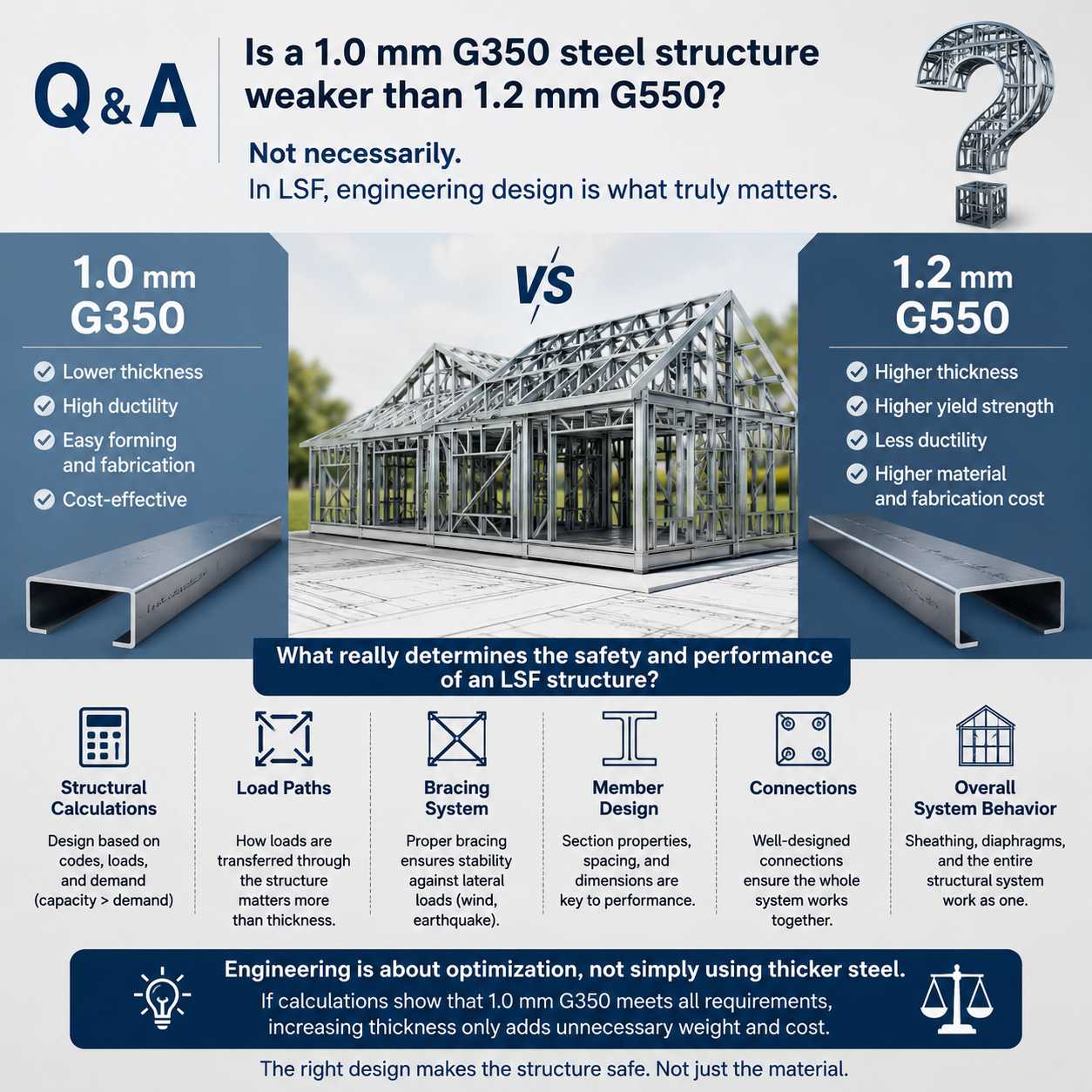
This is a common statement we hear at construction exhibitions and industry events.
But is structural safety really determined only by steel thickness or yield strength?
The answer is NO.
In Light Steel Frame (LSF) engineering, structural performance depends on the complete engineered system:
• Structural calculations
• Load paths
• Bracing systems
• Member spacing
• Connections
• Wind and seismic design
• Overall structural behavior
A properly engineered 1.0 mm G350 system can safely meet all project requirements when designed according to applicable standards and load conditions.
In fact, many international LSF projects successfully use sections from 0.75 mm to 1.0 mm, especially in low-rise residential buildings.
Using G550 steel does not automatically create a better structure either. Higher-strength steel may reduce ductility and can introduce different design and manufacturing considerations.
Engineering is not about using the thickest possible material.
Engineering is about optimization, efficiency, safety, and correct structural design.
If calculations confirm that 1.0 mm G350 satisfies all structural requirements, increasing thickness may simply add unnecessary weight and cost without real engineering benefit.